Most companies think they have a security program because they bought tools, passed an audit, or assigned someone the “security” hat.
But that’s not maturity.
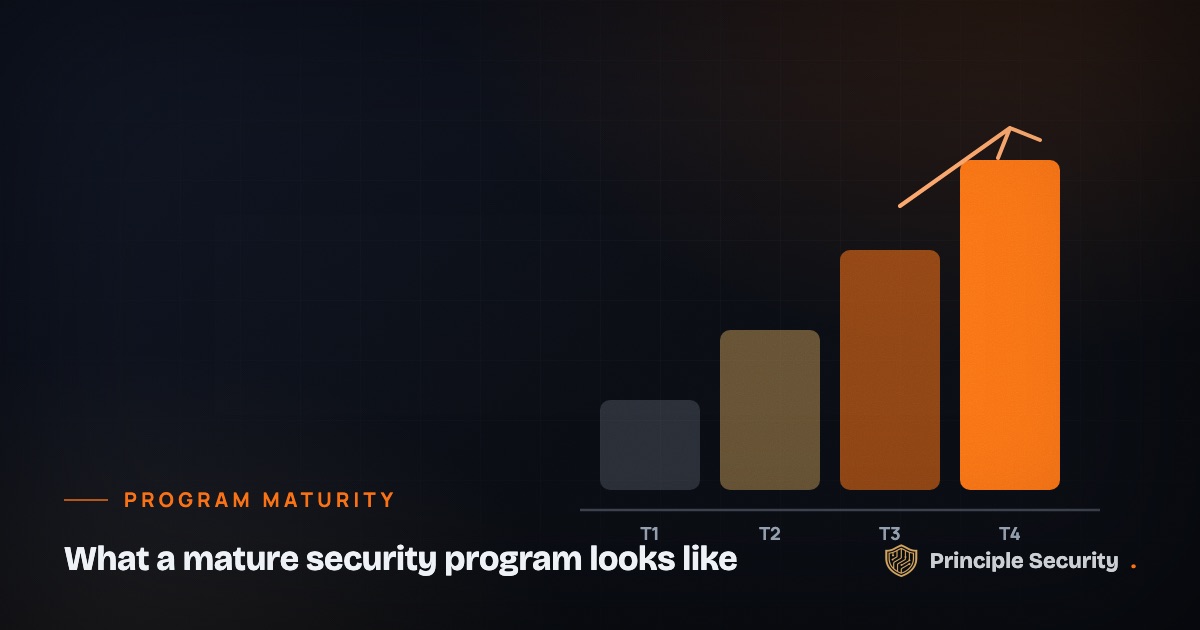
Maturity is when your program consistently reduces risk, defends business continuity, and helps leadership make confident, informed decisions. And it doesn’t happen by accident.
So what does maturity actually look like? Let’s break it down.
If You Can’t Repeat It, You Don’t Have a Program
Too many organizations confuse motion with progress.
Free resource
Score your program in 5 minutes
15 questions mapped to NIST CSF 2.0, including instant tier, per-function scores, and your three biggest gaps.
Get it free →- Scanning for vulnerabilities ≠ patch management.
- Having a SIEM ≠ incident detection.
- Sending phishing tests ≠ building a security-aware culture.
Mature programs don’t just do security things. They do them repeatedly, intentionally, and in alignment with business risk.
If your team can’t show what you do, measure, improve, and report on a quarterly basis, you’re operating on hope, not a program.
People: It’s About Accountability, Not Just Staffing
Maturity doesn’t start with hiring a security engineer. It starts with clarity of ownership:
- Security responsibilities are written into job roles across IT, HR, legal, and operations.
- Business units know who to call when something looks wrong, and what’s expected of them.
- Leadership understands that cybersecurity isn’t IT’s problem. It’s an organizational risk.
Training also shifts from annual “check-the-box” videos to measurable behavior change. Users know what to do when confronted with real threats, because they’ve practiced.
Process: Repeatable, Risk-Aligned, and Resilient
Mature programs don’t rely on heroics. They build in process.
- Incident response is tested quarterly. Not imagined, not printed. Practiced.
- Vulnerability management prioritizes business-critical systems, not just whatever Tenable marked as a 9.3.
- Access reviews aren’t annual panic projects; they’re integrated into offboarding and privilege creep monitoring.
- Third-party risk isn’t “we got a SOC 2.” It’s contractual, continuous, and ranked by business exposure.
Documentation doesn’t live in a policy binder; it fuels decision-making, measurement, and resilience.
Technology: Integrated and Operational, Not Just Purchased
Buying tools is easy. Operationalizing them is the work.
- A mature stack is mapped to risks and outcomes, not buzzwords.
- Logs are centralized, alerts are tuned, false positives are addressed.
- MFA is enforced across all critical services, especially the ones often left out (VPNs, backups, SaaS admin consoles).
- Tools aren’t siloed. Your EDR, SIEM, vulnerability scanner, and IdP talk to each other.
Most importantly, mature orgs retire tech that isn’t providing value. Bloat is risk.
Governance: Risk in Business Terms, Not Just Tech Speak
This is where most security teams fail: translating technical action into business value.
- Metrics are tracked monthly: dwell time, phishing click rates, control drift, budget-to-risk ratios.
- Risk is communicated in dollars, not colors, ideally using a model like FAIR or equivalent.
- Boards get reports that inform investment, not just scare them with headlines.
- Audit evidence is collected continuously, not 72 hours before the deadline.
Mature programs can answer hard questions like:
“What’s the cost if this breaks?”
“How much should we spend to prevent it?”
“What risk are we intentionally accepting?”
Maturity Is a Business Enabler, Not a Gold Star
A mature security program doesn’t just keep auditors happy. It enables growth.
- It builds trust with customers and partners.
- It reduces insurance premiums.
- It creates clarity in chaotic moments (breaches, outages, compliance changes).
- It gives leaders confidence to make bold moves, because risk is known and managed.
And in many cases, maturity costs less than the mess left by a reactive, misaligned, tool-heavy “program” that never quite delivers.
Where to Go From Here
Start by asking this:
“Can we clearly explain how security reduces risk, how we measure that, and how we improve over time?”
If not, it might be time to step back and build the strategy before buying the next product.
Maturity isn’t a point in time. It’s a practice of alignment, measurement, and leadership, and when done right it’s one of the best investments a business can make.
Need a second set of eyes on where your program stands today?
That’s where we come in. Whether you’re building from scratch or refining what’s already there, we help organizations align their security efforts to actual risk and business goals.