The Real Cost of Not Having Security Leadership
Let's skip the scare tactics. You already know your company needs security leadership; that's not the question. The question is what form that leadership should take, and what it should cost.
For most mid-sized companies, the math points clearly in one direction. But the math only works if you're honest about what a full-time CISO actually costs, not just their salary, but the full loaded expense of putting a senior security executive on your payroll.
What a Full-Time CISO Really Costs
When companies budget for a CISO hire, they typically think about salary. A competent CISO (someone with operational experience, not just certifications) commands $300,000 or more in base compensation. That's the starting point, not the total.
Add the costs companies routinely underestimate:
Benefits and payroll taxes add roughly 30% to base salary. For a $300K hire, that's another $90,000 in healthcare, retirement contributions, and employer-side taxes.
Recruiting costs for senior security executives are significant. Executive recruiters typically charge 20-25% of first-year salary. Even amortized over three years, that's $17,000-$25,000 annually.
Ramp time is real money. A new CISO needs 3-6 months to learn your business, assess your environment, build relationships with your IT team and vendors, and develop a strategy. During that period, you're paying full salary for partial productivity. That's $75,000-$150,000 in salary before you see meaningful strategic output.
They still need outside help. Even the best full-time CISO isn't a penetration tester, a forensics analyst, a compliance auditor, and a GRC architect rolled into one. They'll need to hire or contract specialists (pen testing engagements, incident response retainers, compliance consultants. Budget another $35,000-$75,000 annually for the expertise your CISO will need to bring in.
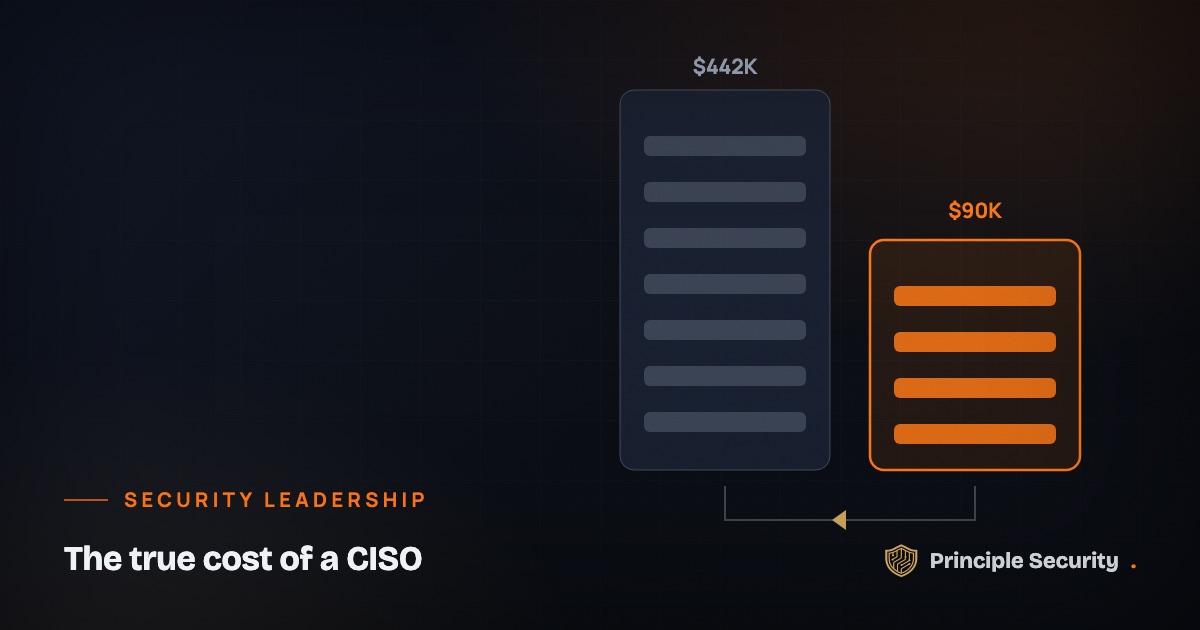
Add it up: a full-time CISO costs $430,000-$550,000 per year when you account for everything. And that's before they ask for budget to build a security team under them.
The vCISO Alternative: Same Leadership, Right-Sized Cost
A vCISO engagement at $250/hour, with a typical commitment of 20-40 hours per month, runs $60,000-$120,000 annually. At the median engagement of 30 hours per month, that's $90,000 per year.
That's roughly 20% of the loaded cost of a full-time hire.
But cost savings alone don't tell the full story. The real value equation comes from what you get for that investment.
One Contract, an Entire Team
This is the advantage most companies don't see until they experience it. When you hire a full-time CISO, you get one person. One skill set. One perspective. When that person needs a penetration test, they hire a firm. When they need compliance expertise, they bring in a consultant. When an incident happens at 2 AM, they're one person trying to coordinate a response.
A vCISO engagement with Principle Security works differently. You get strategic security leadership, but you also get access to an entire bench of specialists, coordinated under one contract:
Compliance and audit navigation: specialists who live in SOC 2, HIPAA, CMMC, and PCI-DSS every day, not a generalist brushing up on the framework before your audit.
Penetration testing and red team operations: offensive security professionals who test your defenses, not your CISO moonlighting with a scanner.
Incident response and forensics: experienced responders who've handled breaches before, not someone reading a playbook for the first time under pressure.
GRC and policy development: governance, risk, and compliance professionals who build programs that work in practice, not just on paper.
Vendor risk and third-party assessment: dedicated evaluators who know what to look for in vendor security posture and contractual obligations.
A full-time CISO would need to source, vet, contract, and manage each of these capabilities separately. With a vCISO engagement, it's one relationship, one contract, and a coordinated team that already works together.
The Flexibility Premium
Security needs aren't constant. You need more hours during audit season, compliance pushes, or after a security incident. You need fewer hours during steady-state operations.
A full-time CISO costs the same whether it's the busiest month of the year or the quietest. A vCISO engagement scales with your needs. Ramp up for a SOC 2 audit, scale back when the certificate is in hand. Surge capacity during an incident, normal cadence when things are stable.
That flexibility means you're paying for leadership when you need it, not carrying overhead when you don't.
Where the Savings Go
The difference between a vCISO engagement and a full-time hire isn't just money saved; it's budget freed up for the security controls and capabilities your program actually needs.
At a typical 30-hour engagement ($90K/year) versus a loaded full-time cost ($430K+), you have over $340,000 in annual savings that can fund:
Security tools and platforms: EDR, SIEM, vulnerability management, identity governance. The tools your vCISO recommends based on your actual risk profile, not a vendor's sales pitch.
Employee security training: real behavior-change programs, not annual compliance videos nobody watches.
Incident response retainers: pre-negotiated access to IR firms so you're not scrambling during a crisis.
Cyber insurance improvements: better security posture means better premiums and broader coverage.
The point isn't just spending less. It's investing the difference where it actually reduces risk.
When Does a Full-Time CISO Make Sense?
This isn't about one model being universally better. A full-time CISO makes sense when your organization has grown to the point where you need daily strategic oversight, typically when you have a dedicated security team to manage, a complex multi-regulatory environment, and a budget that supports both the executive and the program they'll build.
For most companies between 50 and 500 employees, that tipping point hasn't arrived. And forcing a full-time hire before the organization is ready often leads to a frustrated CISO, a misaligned program, and a budget that can't support both the executive and the tools they need.
A vCISO lets you build the program first. When the program matures to the point where full-time leadership is justified, you'll know, and you'll have the infrastructure in place to make that hire productive from day one.
Run the Numbers Yourself
We've built an interactive calculator that lets you plug in your specific numbers (hours per month, hourly rate, comparable CISO salary), and see exactly how the costs compare. No forms to fill out, no email required. Just the math.
Try the vCISO Cost Calculator →
The Bottom Line
A vCISO at $250/hour sounds expensive until you compare it to the alternative. At 30 hours per month, you're investing $90,000 annually in strategic security leadership backed by a full team of specialists. The full-time alternative costs $430,000+ for one person who'll still need to hire outside help.
The question isn't whether $250/hour is a lot of money. The question is whether $430,000 for one person is a better use of your security budget than $90,000 for a team.
For most growing companies, the answer is clear.
Ready to explore whether a vCISO is the right fit? Let's talk →