The Security Leadership Gap Most Companies Ignore
Here's a pattern that plays out constantly: a company grows past 50 employees, wins a few enterprise contracts, and suddenly faces security questionnaires, compliance requirements, and board-level questions about risk. The IT team (often a single person or a small managed services provider) doesn't have the answers. Not because they're not good at their jobs, but because cybersecurity strategy isn't the same discipline as keeping laptops running and email flowing.
The company needs a Chief Information Security Officer. What it doesn't need is a $250,000-to-$400,000 full-time hire who'll spend half their time in an organization that doesn't yet have enough security infrastructure to manage full-time.
That's the gap a vCISO fills.
What a vCISO Actually Is
A virtual Chief Information Security Officer (vCISO, sometimes called a fractional CISO) is an experienced security executive who works with your company on a part-time, outsourced, or retainer basis. They bring the same strategic leadership as a full-time CISO, but scoped to what your organization actually needs right now.
This isn't a consultant who drops off a PDF and disappears. A good vCISO embeds into your operations. They attend your leadership meetings. They talk to your IT team, your compliance people, your vendors. They own the security strategy the same way a full-time CISO would, just across a portfolio of clients instead of sitting in one office five days a week.
The "virtual" in vCISO refers to the engagement model, not the depth of involvement. The work is real. The accountability is real. The outcomes are real.
What a vCISO Does Day-to-Day
The scope varies by engagement, but a vCISO typically owns or drives:
Security Program Development. Most growing companies don't have a formal security program. They have tools, maybe an antivirus product, a firewall, some form of endpoint protection, but no documented strategy tying those tools to business risk. A vCISO builds the program: policies, procedures, risk assessments, incident response plans, and the roadmap to mature it over time.
Risk Assessment and Prioritization. Not all risks are equal, and not all of them need to be addressed immediately. A vCISO evaluates your threat landscape, identifies the exposures that actually matter to your business, and helps you spend security dollars where they'll have the most impact. This is the difference between buying tools because a vendor scared you and investing in controls because the risk justified it.
Compliance and Regulatory Navigation. Whether it's SOC 2, HIPAA, CMMC, PCI-DSS, or state privacy laws, compliance frameworks drive a lot of security spending. A vCISO translates those requirements into practical controls, not gold-plated implementations that drain your budget, but right-sized programs that satisfy auditors and actually reduce risk.
Vendor and Technology Oversight. Someone needs to evaluate whether your MSP is actually doing what they claim. Someone needs to review contracts with SaaS vendors who'll be handling your data. Someone needs to assess whether that shiny new security tool is worth the license fee or if it's solving a problem you don't have. That someone is your vCISO.
Board and Executive Communication. Security leaders don't just manage firewalls; they translate technical risk into business language. When your board asks "are we secure?" a vCISO provides an answer that's honest, specific, and tied to business impact. No jargon. No fear-mongering. Just a clear picture of where you stand and what you're doing about it.
Incident Response Leadership. When something goes wrong, and eventually something will, you need someone who's managed incidents before. A vCISO brings the experience to coordinate your response, communicate with stakeholders, manage legal and regulatory obligations, and make sure the organization learns from the event instead of just surviving it.
Who Actually Needs a vCISO
The short answer: companies that have outgrown "IT handles security" but haven't reached the scale where a full-time CISO makes financial sense.
In practice, that covers a wide range:
Companies with 50 to 500 employees that are landing enterprise clients who require evidence of a security program. Those security questionnaires and vendor risk assessments won't fill themselves out, and "our IT guy handles that" isn't an answer that wins deals.
Organizations facing their first compliance audit. Whether it's a client demanding SOC 2 or a regulatory body requiring HIPAA controls, the gap between "we think we're compliant" and "we can prove it" is enormous. A vCISO closes that gap without the overhead of a permanent executive hire.
Private equity portfolio companies that need to demonstrate security maturity to investors or as part of due diligence. PE firms increasingly view cybersecurity posture as a valuation factor, not just a cost center.
Companies that have experienced a breach or near-miss and recognize they need strategic security leadership, not just another tool purchase.
Any organization where the CEO, CFO, or IT director is currently the de facto security decision-maker and knows they shouldn't be. Security strategy requires specialized expertise. Distributing that responsibility across people who have other full-time jobs creates gaps.
The vCISO vs. Full-Time CISO Decision
This isn't about one being better than the other. It's about matching the engagement model to the organization's reality.
A full-time CISO makes sense when your organization has a dedicated security team to manage, a complex enough environment to require daily strategic oversight, and a budget that supports a senior executive salary plus the program they'll need to build. For most Fortune 1000 companies, this is the right answer.
A vCISO makes sense when you need the strategic leadership but can't justify, or can't find, a full-time hire. The cybersecurity talent market is brutally competitive. Experienced CISOs command significant compensation, and smaller organizations often can't match the packages offered by larger enterprises. A vCISO gives you access to that same caliber of experience at a fraction of the cost.
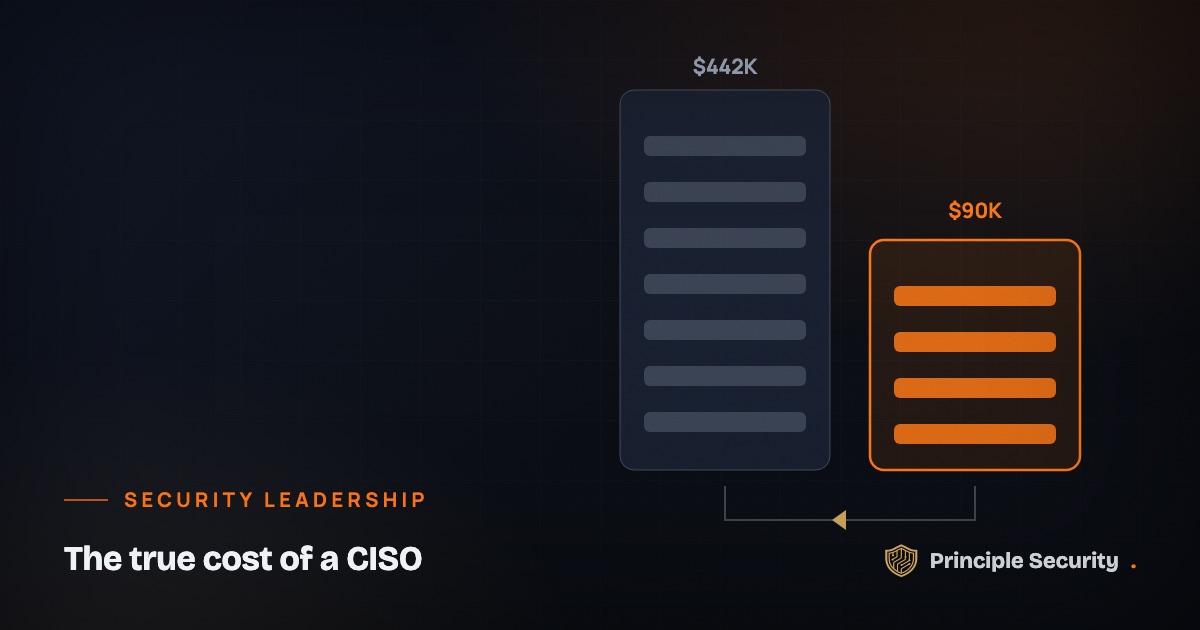
The math is straightforward. A full-time CISO costs $250K-$400K in salary alone, plus benefits, plus the inevitable budget they'll need to build out a team and toolset. A vCISO engagement typically runs $5,000-$15,000 per month depending on scope and complexity. For many growing organizations, that's the difference between having security leadership and not having it.
What a vCISO Is Not
Clarity matters here, because the market is full of vendors who slap "vCISO" on services that aren't.
A vCISO is not a managed security service. MSSPs monitor your alerts and manage your tools. A vCISO sets the strategy those tools support. These are complementary, not interchangeable.
A vCISO is not a penetration tester or auditor. Those are point-in-time assessments. A vCISO provides ongoing strategic direction. They might commission a pen test, but they're not the ones running Nmap scans.
A vCISO is not a compliance checkbox. If someone offers to "be your vCISO" by handing you a stack of policy templates and calling it done, that's not leadership; that's a document sale with a fancy title.
The real test: does your vCISO know your business? Can they explain your top three security risks without looking at notes? Do they push back when you want to skip something important? Do they show up to your leadership meetings prepared with context, not just slides?
If yes, you've got a vCISO. If no, you've got a vendor.
What to Look for When Hiring a vCISO
Not all vCISO providers are equal. Here's what separates the ones who drive outcomes from the ones who generate reports:
Operational experience, not just certifications. Certifications matter, but you want someone who's built security programs, managed incidents, and navigated real compliance audits, not someone whose experience is primarily theoretical.
Industry relevance. A vCISO who's worked in healthcare will ramp faster if you're a healthcare company. The frameworks, threat models, and regulatory landscape vary significantly across industries. General cybersecurity knowledge is necessary but not sufficient.
Communication skills. Your vCISO will need to present to your board, negotiate with vendors, coach your IT team, and sometimes deliver hard truths to leadership. Technical depth without communication ability is a liability at the executive level.
A defined engagement model. You should know exactly what you're getting: hours per month, deliverables, meeting cadence, response times, escalation paths. Vague "we'll be available" arrangements lead to vague results.
Willingness to be accountable. The best vCISOs tie their work to measurable outcomes (risks mitigated, compliance milestones achieved, incident response times improved, security questionnaire completion rates. If they can't point to what's changed since they started, something's wrong.
How Principle Security Approaches vCISO Engagements
We built our vCISO practice around a simple belief: security leadership should produce measurable business outcomes, not just documentation.
Every engagement starts with understanding your business, not your technology. What markets do you serve? What does your client base expect? What regulatory frameworks apply? Where is the company headed in 12-24 months? The security strategy follows the business strategy, not the other way around.
From there, we build a prioritized roadmap that addresses your actual risks, not a generic maturity model that treats every company the same. We focus on the controls that reduce the most risk for the least disruption, and we're transparent about what's important now versus what can wait.
We integrate with your existing IT team and vendors rather than replacing them. Your MSP, your IT director, your compliance team, they're part of the solution. Our job is to provide the strategic direction and oversight they need, not to create a parallel operation.
And we measure what matters. Every quarter, we report on concrete outcomes: risks closed, compliance gaps addressed, incidents handled, and the overall trajectory of your security posture. If we can't show progress, we haven't done our job.
The Bottom Line
A vCISO isn't a compromise. It's a deliberate decision to get experienced security leadership matched to your organization's current scale and needs. For companies that have outgrown ad-hoc security but haven't reached enterprise scale, it's often the smartest move available.
The question isn't whether you need security leadership. If you're reading this, you probably already know you do. The question is whether you need that leadership sitting in your office full-time, or whether you need it showing up with the right experience, at the right cadence, focused on the outcomes that actually move your business forward.
If you're weighing that decision, we should talk.
Ready to explore whether a vCISO is the right fit for your organization? Get Started →