Most organizations rate cyber risk as High, Medium, or Low. Those labels feel meaningful inside the security team. But walk into a board meeting or a budget conversation with a CFO and they fall apart fast.
The FAIR risk model (Factor Analysis of Information Risk) was built to answer those questions. It is the only open standard for quantifying cybersecurity risk in financial terms, and it is increasingly the language that boards, CFOs, and cyber insurers expect.
This guide covers what FAIR is, how it works, how it compares to qualitative methods and NIST CSF, and whether it is the right fit for your organization.
What Does FAIR Stand For?
FAIR stands for Factor Analysis of Information Risk. It was developed by Jack Jones in the early 2000s while he was serving as CISO at Nationwide Insurance, and later adopted by The Open Group as an international open standard, formally designated Open FAIR (O-RA and O-RT).
The core premise is straightforward: risk is a function of how often a loss event is likely to occur and how much it will cost when it does.
That sounds simple. The discipline is in estimating those two factors rigorously, using calibrated judgment, threat intelligence, and historical data, rather than assigning a color on a heatmap and moving on.
How the FAIR Model Works
FAIR breaks risk into two top-level components, each with structured sub-factors.
Free resource
Free 16-page guide: FAIR for the Boardroom
Loss-exposure curves, a worked ransomware example, and the five slides that get budgets approved.
Get it free →Loss Event Frequency (LEF)
How often can you expect a loss event to occur within a given time period? LEF is driven by two sub-factors:
- Threat Event Frequency (TEF): How often does the threat actor attempt an action against this asset? This draws on threat intelligence, industry incident data, and the specific attacker profile relevant to your organization.
- Vulnerability (VULN): Given that the threat actor acts, what is the probability their action succeeds? This is a function of your controls (technical, procedural, and physical), relative to threat actor capabilities.
A highly motivated attacker targeting a weakly controlled asset produces high loss event frequency. A sophisticated attacker targeting a hardened environment produces low frequency even if the threat itself is severe.
Loss Magnitude (LM)
When a loss event occurs, how much does it cost? FAIR divides this into two buckets:
- Primary Loss: Direct costs (response and remediation costs, lost productivity, asset damage, competitive advantage loss.
- Secondary Loss: Downstream costs (regulatory fines, litigation, customer churn, reputational damage, credit impacts.
Secondary losses are often larger than primary losses and are consistently underestimated in qualitative assessments. A data breach that costs $200,000 to remediate can generate $2M or more in secondary losses through regulatory penalties, class action exposure, and customer attrition.
Monte Carlo Simulation
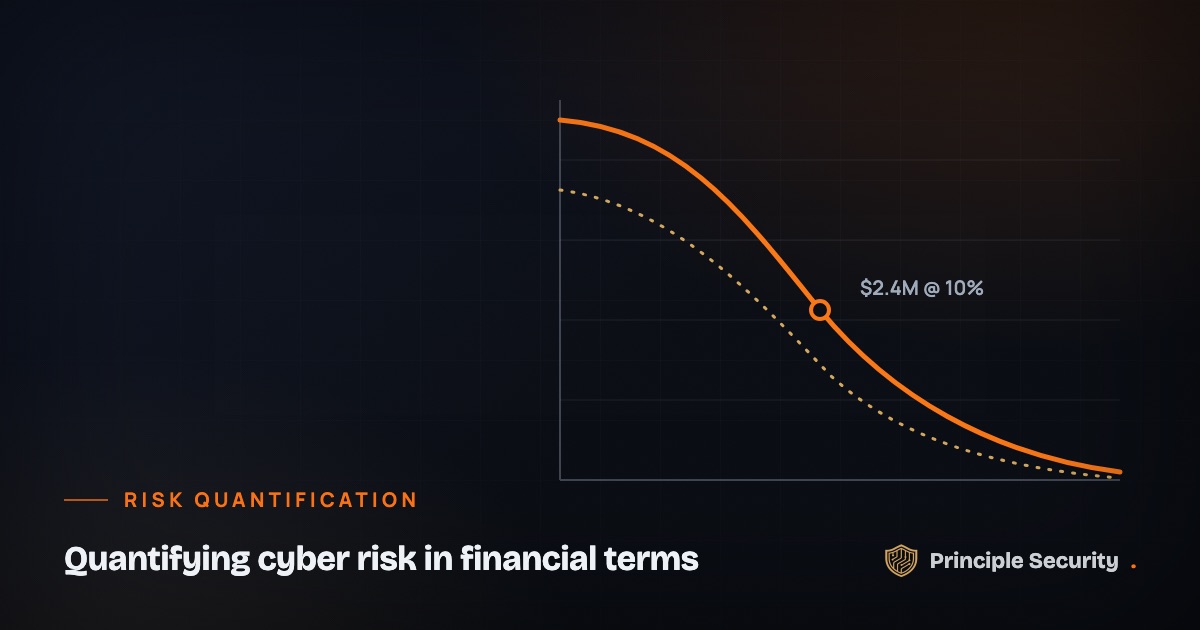
Rather than producing a single point estimate, FAIR uses Monte Carlo simulation to generate a probability distribution of outcomes. You input ranges for each factor and the model runs thousands of simulations to produce an output like: There is a 10% probability this scenario results in losses exceeding $3.2M in the next 12 months. The expected annual loss is $820,000.
That is a sentence a CFO can act on. A red square on a heatmap is not.
FAIR vs. Qualitative Risk Methods
Qualitative risk ratings have been the default in cybersecurity for decades. They are fast, require no data, and produce outputs most security teams are comfortable with. They are also deeply limited as a basis for decisions.
The problems are structural. Ratings are subjective; one analyst's High is another's Medium. A $50,000 risk and a $5,000,000 risk can both score High, making prioritization between them impossible. Qualitative ratings cannot be aggregated across business units and are meaningless to financial decision-makers who operate in dollar terms.
FAIR does not replace qualitative methods at the screening stage. A risk register of 200 items benefits from quick qualitative triage. But when it comes to prioritizing investments, justifying budget, or communicating risk to executive leadership, quantitative analysis is the right tool.
FAIR vs. NIST CSF: Are These Competing Frameworks?
NIST CSF is a controls framework. It tells you what security capabilities to implement across five functions: Identify, Protect, Detect, Respond, Recover. It is an excellent organizing structure for a security program and maps well to regulatory requirements.
FAIR is a risk quantification model. It tells you how to measure the financial impact of a given risk scenario, and therefore which controls to prioritize implementing first.
They are complementary. Use NIST CSF to identify control gaps, then use FAIR to quantify the risk those gaps represent in financial terms. Prioritize remediation based on which gaps carry the highest expected loss. Report to the board: closing this control gap reduces our expected annual loss exposure by $1.4M, and the project costs $200,000.
Who Should Use FAIR Risk Analysis?
FAIR is a strong fit for organizations that present cybersecurity risk to a board or C-suite that expects financial context, need to justify security budget decisions against competing capital priorities, are subject to regulatory requirements such as SOC 2, HIPAA, CMMC, or FFIEC, or are evaluating cyber insurance coverage.
FAIR may be premature if the organization lacks a current asset inventory, if no executive above the security team will act on the output, or if the security program is still in early build-out mode and needs controls more urgently than metrics.
How to Conduct a FAIR Analysis: Step by Step
Step 1: Define the risk scenario. Be specific. Ransomware targeting your EHR system initiated by a financially motivated criminal group is a FAIR scenario. Cybersecurity risk is not.
Step 2: Estimate Loss Event Frequency. How many times per year could this threat actor act against this asset? Draw on threat intelligence feeds, the Verizon DBIR, and internal logs. FAIR works with calibrated ranges when hard data is unavailable.
Step 3: Estimate Vulnerability. Given the threat acts, what is the probability of success given your current controls? Be honest about detection gaps and delayed response times.
Step 4: Estimate Loss Magnitude. For primary losses: response and forensics costs, system downtime, notification. For secondary losses: regulatory exposure, litigation risk, customer impact.
Step 5: Run the Monte Carlo simulation. RiskLens is the most widely used commercial option. FAIR-U is a free entry-level tool from the FAIR Institute.
Step 6: Interpret and communicate the output. Present the result as a range with probabilities, not a single number.
Step 7: Translate for stakeholders. For a CFO: this scenario carries an expected annual loss of $X, with a 10% chance of exceeding $Y. For a board: our ransomware exposure represents approximately $Z in expected losses per year; here is what it would cost to reduce that by 60%.
Common FAIR Implementation Mistakes
Scope too broad from the start. Begin with three to five high-priority scenarios and build rigor before expanding.
Waiting for perfect data. FAIR is designed to work with calibrated estimates. Refusing to proceed until you have actuarial-quality data means never starting.
Treating it as a one-time exercise. Models should be refreshed at least annually, or when material changes occur in the threat landscape or organizational controls.
Underestimating secondary losses. Teams consistently anchor on remediation costs and miss regulatory exposure, litigation, and customer attrition. Build secondary loss estimation into your process from the start.
Is FAIR Right for Your Organization?
FAIR delivers sustained value when embedded in an ongoing risk management program, not run once, filed away, and forgotten. The organizations that get the most from it use FAIR outputs to drive budget conversations, inform control prioritization, and brief their boards on a regular cadence.
For mid-market organizations without a dedicated risk quantification team, the most practical path to FAIR adoption is partnering with practitioners who have implemented it before. That means faster time to value, fewer calibration errors, and outputs defensible to auditors and insurers from day one.
At Principle Security, our Compliance and Risk Management practice uses FAIR-based quantification as the foundation of every risk assessment engagement. We translate your specific threat landscape and control environment into loss distributions your board and CFO can act on.
Ready to move beyond the heatmap? Talk to our team about what a FAIR-based assessment looks like for your organization.
FAIR Resources and Further Reading
- The Open Group Open FAIR Standard, the formal O-RA and O-RT specifications
- FAIR Institute (fairinstitute.org), practitioner community, free training, and FAIR-U tooling
- Measuring and Managing Information Risk by Jack Jones and Jack Freund, the foundational FAIR text
- Principle Security Compliance and Risk Services, how we apply FAIR in client engagements